⏱️ Reading time: 6 minutes
In this article
There's a reason "French girl hair" has become one of the most searched beauty aesthetics on the internet. It's not the result of a specific product or a complicated technique. It's a philosophy, and once you understand it, it's surprisingly simple to adopt.
I'm Patricia Debrant, the founder of Mon SHAMPOING. I'm French, I've spent over a decade formulating hair care products, and I've had this conversation more times than I can count: American women asking me what French women actually do differently. The answer is almost always the same, and it almost always surprises them.
They do less. Intentionally.
The myth vs. the reality
Let's start with what French girl hair is not.
It's not about having naturally perfect hair. It's not about skipping products entirely. And it's definitely not about being effortlessly beautiful without trying, that's a carefully constructed image, not a reality.
What it actually is: a consistent, minimal, intentional approach to hair health built around working with your hair's natural biology rather than constantly overriding it. The French approach to hair care has the same underlying logic as the French approach to skin care and food, quality over quantity, restraint over excess, and a deep skepticism of anything that promises dramatic overnight results.
The aesthetic outcome - that undone, slightly textured, genuinely healthy-looking hair - is a byproduct of the approach, not the goal itself.
The five principles behind French haircare
1. Less washing, not more
The average American washes their hair 4–5 times a week. The average French woman, 2–3 times. This isn't laziness, it's biology. Every time you shampoo, you strip the scalp of its natural sebum. The scalp responds by producing more. Wash less frequently, and over 4–6 weeks, sebum production regulates itself. Your hair stays cleaner for longer, naturally.
2. Scalp first, lengths second
French haircare is scalp-centric. A healthy scalp is treated with the same seriousness as a healthy complexion, because it functions the same way. Regular gentle cleansing, occasional exfoliation, and scalp-specific treatments are prioritized over obsessing over the lengths. The logic: healthy hair starts at the root, not the ends.
3. Fewer products, better ingredients
The French approach is deeply skeptical of 12-step routines. The preference is for a small number of products with clean, effective formulas that do exactly what they claim. Ingredient labels get read. Sulfates, silicones, and parabens are avoided, not because of trends, but because of a long-standing cultural preference for formulas that respect the body's natural balance.
4. Heat styling as the exception, not the rule
Blow-drying every day is an American habit that most French women find genuinely puzzling. Air-drying is the default. Heat tools are used occasionally, for specific occasions, and always with protection. The result is hair that retains its natural texture and doesn't depend on styling to look good.
5. Texture is an asset, not a problem to fix
Perhaps the most fundamental difference: French women don't fight their natural hair texture. Waves, slight frizz, movement, these are features, not flaws. The goal is enhancing what's naturally there, not achieving a uniform, processed perfection.
The actual routine, step by step
Here's what a French-inspired hair routine looks like in practice, adapted for real life, not a Pinterest board.
🗓️ 2–3 times per week - wash day
Step 1 : Optional scalp scrub (once a week or every two weeks)
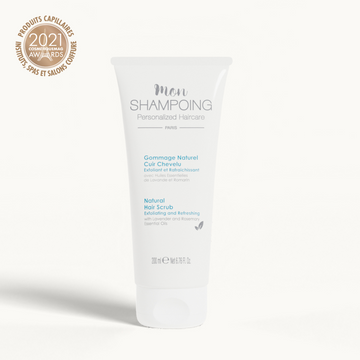
A gentle scalp exfoliant removes product build-up, excess sebum, and any environmental residue before shampooing. Think of it as prepping a clean canvas. This step alone - done consistently - makes a visible difference in scalp health and hair vitality within a few weeks.
Step 2 : Shampoo, focused on the scalp
Apply shampoo to the roots and scalp only. Work it in with fingertip massage, this stimulates circulation and helps the formula do its job. The lengths don't need direct shampooing; the rinse water running through them is sufficient. This prevents the chronic dryness that comes from over-cleansing the mid-lengths and ends.
The Mon SHAMPOING customization system pairs a vegetal keratin base shampoo with an essential and vegetable oil booster matched to your hair type, so your shampoo is actually formulated for your specific hair, not a generic crowd-pleaser.
Step 3 : Conditioner or mask, focused on the lengths
The opposite of shampoo: apply conditioner or a nourishing mask from mid-length to ends only, never on the scalp. Leave for the recommended time, actually leave it, don't rinse after 30 seconds. Rinse with cool water to seal the cuticle.
Step 4 : Leave-in and air dry
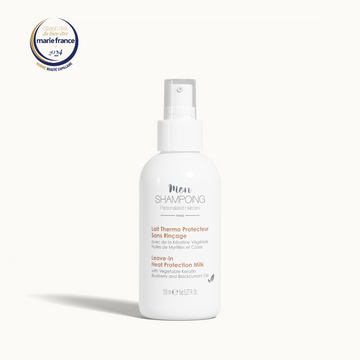
On damp hair, apply a lightweight leave-in treatment to add moisture, reduce frizz, and protect while drying. Then let it dry naturally. Resist the urge to touch it while it dries, manipulation while wet causes frizz and disrupts the natural pattern.
💡 The transition period
If you're used to washing daily, switching to 2–3 times a week will feel uncomfortable for the first 2–3 weeks while your scalp adjusts its sebum production. Dry shampoo can help bridge the gap. Push through, the payoff on the other side is hair that genuinely needs less intervention to look good.
🗓️ Between washes - daily
This is where most people over-complicate things. Between washes, French haircare is minimal by design:
- A few drops of leave-in spray on dry ends if needed
- A loose braid, bun, or natural wear, no tight elastics, no excessive brushing
- Silk or satin pillowcase to minimize friction overnight
- That's it
What French women actually look for in products
The French clean beauty movement predates the American one by at least a decade, not as a marketing category, but as a genuine consumer reflex. Reading ingredient labels, questioning formulas, and demanding transparency from brands is the norm, not the exception.
In practice, that means avoiding:
- Sulfates (SLS, SLES) : aggressive surfactants that strip the scalp's natural lipid barrier
- Silicones : create an illusion of smoothness by coating the hair, but build up over time and prevent moisture from entering the fiber
- Parabens : preservatives with documented endocrine-disrupting properties
- Synthetic fragrances : often a cocktail of undisclosed chemicals; natural essential oils are preferred
And actively seeking:
- Hydrolyzed vegetal keratin : rebuilds the hair's structural protein from within
- Plant-derived oils (argan, camellia, jojoba, marula) : for genuine nourishment rather than surface coating
- Essential oils : chosen for their specific functional properties (eucalyptus for scalp health, lavender for balance, peppermint for circulation)
The American habits that work against you
This isn't a criticism, it's an observation, and it comes from years of formulating products for both markets. The American hair care industry is built around a high-frequency, high-product model that, paradoxically, often makes hair more dependent on intervention rather than less.
🚫 Washing daily: strips natural oils, triggers overproduction of sebum, creates a cycle that's hard to break without a transition period.
🚫 Using heat every day: cumulative thermal damage that compounds over months and years : dryness, breakage, loss of natural texture.
🚫 Applying too many products at once: multiple serums, creams, and sprays layered on top of each other often cancel each other out, or create build-up that weighs hair down and clogs the scalp.
🚫 Expecting instant results: the American beauty market is heavily oriented toward dramatic, fast transformation. Hair health, real hair health, is built over weeks and months of consistent, simple care. Products that promise instant results are almost always using coating agents that create a temporary illusion.
🚫 Treating all hair concerns with volume: more product, more steps, more treatments. The French instinct when something isn't working is to subtract, not add.
How to start today
You don't need to overhaul your entire routine overnight. Start with one change and let it compound.
The highest-impact first step: skip one wash this week. Just one. Use dry shampoo at the roots if needed. See how your hair responds by day 3. Most people are genuinely surprised, the hair often looks better, not worse, when given a chance to find its natural balance.
From there, layer in the other principles gradually. Swap your sulfate shampoo. Try air-drying once. Put down the flat iron for a week. Each small change builds on the last, and within 4–6 weeks, you'll have a routine that requires less effort and produces better results than what you're doing now.
Not sure where to start with products? Our 2-minute hair quiz matches you with the right shampoo and booster combination for your specific hair type and goals, it's the fastest way to build a French-inspired routine that's actually tailored to you.
"The most common thing I hear from American customers after a few weeks on our routine is: 'I can't believe I was working so hard against my own hair.' That's the shift. Once you stop trying to fix your hair and start supporting it instead, everything changes."
- Patricia Debrant, founder of Mon SHAMPOING
Build your French hair routine - customized to you
Mon SHAMPOING was created in France around one idea: that great hair shouldn't require 12 products and daily effort. Take our quiz and find the routine that works with your hair, not against it.
Frequently asked questions about the French girl hair routine
How often should I wash my hair if I want to follow a French hair routine?
The target for most hair types is 2–3 times per week. If you currently wash daily, reduce by one day per week for two weeks, then reduce again. The transition takes 3–4 weeks while your scalp recalibrates its sebum production. It's uncomfortable at first, that's normal. By week 5 or 6, most people find their hair genuinely stays cleaner for longer without any extra effort.
Does the French hair routine work for curly or textured hair?
Absolutely, in fact, many of the principles are especially beneficial for textured hair. Washing less frequently preserves natural curl pattern and prevents the chronic dryness that over-cleansing causes. Focusing on scalp health, using clean formulas without silicone build-up, and embracing natural texture rather than fighting it are all principles that align perfectly with curly and textured hair care. The specific products you choose within the routine should be tailored to your texture, which is exactly what our customization system is designed for.
What is the "French girl hair" aesthetic, exactly?
It's characterized by hair that looks healthy and natural rather than heavily styled, some movement, some texture, a certain undone quality that reads as effortless. Think less "blowout" and more "slept well and my hair looks good anyway." The key distinction is that it's the result of hair that's genuinely in good condition, not a styling technique layered on top of damaged or over-processed hair. You can't fake it with products alone, the underlying hair health has to be there.
Can I follow a French hair routine if I color my hair?
Yes, and it's actually especially beneficial for color-treated hair. Washing less frequently slows color fade significantly (each wash strips some pigment, so fewer washes means longer-lasting color). Using sulfate-free formulas protects color molecules. And prioritizing repair ingredients like vegetal keratin helps compensate for the structural damage that bleaching and coloring cause. The French routine and color-treated hair are entirely compatible, you just want to make sure your products are specifically sulfate-free and color-safe.
Is Mon SHAMPOING a French brand?
Yes, Mon SHAMPOING was founded by Patricia Debrant in France and formulated around French clean beauty principles. The brand is available in the US, UAE, and Mauritius, with formulas that remain consistent across all markets: sulfate-free, silicone-free, paraben-free, and built around hydrolyzed vegetal keratin as the core active ingredient. The customization system, choosing your shampoo base and booster based on your specific hair type, was developed to replace the one-size-fits-all approach that dominates the mass hair care market.
Less effort, better hair. That's the whole idea. 🌿
With love,
Patricia